
Field notes
Winter Solar Output: How Much Power You Actually Get in December (By US Region)
September 12, 2026
If there's one fact that ends off-grid solar dreams, it's this: a solar array that fully charges your battery in July will leave you running a generator every third day in December. Winter sun is a different animal, and most people discover this in their first December off-grid — when the panels they sized for summer suddenly produce half what they expected.
Here's the real December output across the US, what it means for your system, and how to size for the dark months without going bankrupt on panels.
Why winter output crashes
Three things stack against you in December:
- Lower sun angle. The sun is lower in the sky, so even at noon the light hits your panels at a steeper angle, delivering less energy per square foot. The same panel that sees 1,000 W/m² in June sees ~600 W/m² at noon in December at mid-latitudes.
- Shorter days. December has ~9 hours of daylight in most of the US vs. ~15 in June — and the useful solar window (where output exceeds ~10% of rated) shrinks from ~10 hours to ~4–5 hours.
- More clouds. Many regions (Pacific Northwest, Great Lakes, Northeast) get the bulk of their annual cloud cover in winter. A cloudy December day can yield under 5% of a clear-day output.
Realistic December peak-sun-hours by region
Peak sun hours (PSH) is the standard unit — it's the equivalent number of hours per day that your panels receive full "test" sunlight. Here's what December actually delivers, averaged from NREL data:
| Region | June PSH | December PSH | Ratio |
|---|---|---|---|
| Southwest (AZ, NM, southern NV) | 7.5 | 4.5 | 60% |
| Southern California (coast) | 6.5 | 4.0 | 62% |
| Texas / Gulf South | 6.0 | 3.5 | 58% |
| Southeast (FL, GA, SC) | 5.8 | 3.2 | 55% |
| Mid-Atlantic (VA, NC) | 5.5 | 2.8 | 51% |
| Midwest (OH, IN, IL) | 5.5 | 2.2 | 40% |
| Northeast (NY, New England) | 5.5 | 2.0 | 36% |
| Great Lakes (MI, WI, upstate NY) | 5.5 | 1.7 | 31% |
| Pacific Northwest (WA, OR) | 5.0 | 1.2 | 24% |
| Alaska | 5.0 | 0.5 | 10% |
A panel array sized for July in Seattle produces 24% of its summer output in December. In Phoenix it produces 60%. The same panels, the same formula — wildly different winter reality.
What this means for your battery bank
The single biggest winter-sizing mistake: sizing the battery for one night's use but not for a string of cloudy days. A clear December day in the Pacific Northwest gives you ~1.2 PSH. A cloudy December day might give you 0.3 PSH — essentially nothing. Three cloudy days in a row is normal in December in many regions.
If your daily draw is 1,500 Wh and you get three cloudy days, you need 4,500 Wh of usable storage just to survive — before the sun comes back. That's a 400Ah 12V LiFePO4 battery minimum, just to bridge the clouds.
Most off-grid systems sized for summer have one night's worth of storage, not three cloudy days' worth. This is why the generator comes out in January.
How to size for winter (without buying 2x panels)
You have three options, and most real systems use all three:
1. Size the array for December, not June
The math: Panel watts = (Daily Wh ÷ December PSH) ÷ 0.7
For 1,500 Wh/day in the Pacific Northwest (1.2 PSH in December):
1,500 ÷ 1.2 ÷ 0.7 = ~1,800W of panels
For the same load in Phoenix (4.5 PSH):
1,500 ÷ 4.5 ÷ 0.7 = ~475W of panels
Four times the panels for the same daily load, just because of winter. This is why location is the single biggest factor in off-grid solar cost.
2. Tilt the panels steeper in winter
A fixed array at your latitude angle is a year-round compromise. In winter, a steeper tilt (latitude + 15°) captures more of the low winter sun and sheds snow. If you can manually adjust tilt twice a year, do it: steeper in October, flatter in April. Some van and cabin arrays use adjustable legs for exactly this reason.
In snowy climates, steeper tilt also keeps the array clear — a snow-covered panel produces nearly nothing, and a flat panel can stay covered for weeks.
3. Have a winter backup source
Almost no off-grid system in the northern US runs on solar alone year-round without a backup. Your options:
- Generator — cheap to buy, expensive to run. Best for occasional cloudy stretches.
- Wind — viable in some regions; complements solar since cloudy winter days are often windy.
- Grid-tie with battery backup — if you have grid access, this is the most cost-effective winter strategy: solar in summer, grid in winter, battery for outages.
- Propane/diesel heater + minimal electric load — reducing winter electrical demand is often cheaper than increasing winter generation. See our propane vs gasoline vs diesel generator comparison.
A realistic winter strategy for a van or cabin
For a 1.5 kWh/day system in the northern US:
- Panels: size for December PSH (1.5 kWh ÷ 2.0 ÷ 0.7 = ~1,070W — call it 1,000–1,200W)
- Tilt: adjustable, set to latitude + 15° from October to March
- Battery: 3 days of autonomy (4,500 Wh usable) = ~400Ah LiFePO4 at 12V or ~200Ah at 24V
- Backup: a 2,000W inverter generator for stretches of 3+ cloudy days
- Load management: switch fridge to propane in deep winter, use LED lighting, defer laundry to sunny days
Don't panic — but don't size for summer
The good news: winter output is predictable. Once you know your region's December PSH, the math is straightforward, and the GetWattLogic calculator lets you set your climate region and sizes the array for realistic conditions. The bad news: if you sized for June, you will run a generator in January. Plan for December up front, and the rest of the year is easy.
For panels, batteries, and generators that work in cold climates, the Recommended Gear page lists current models with cold-weather notes.
Gear for this setup
Picks that match what this guide covers.
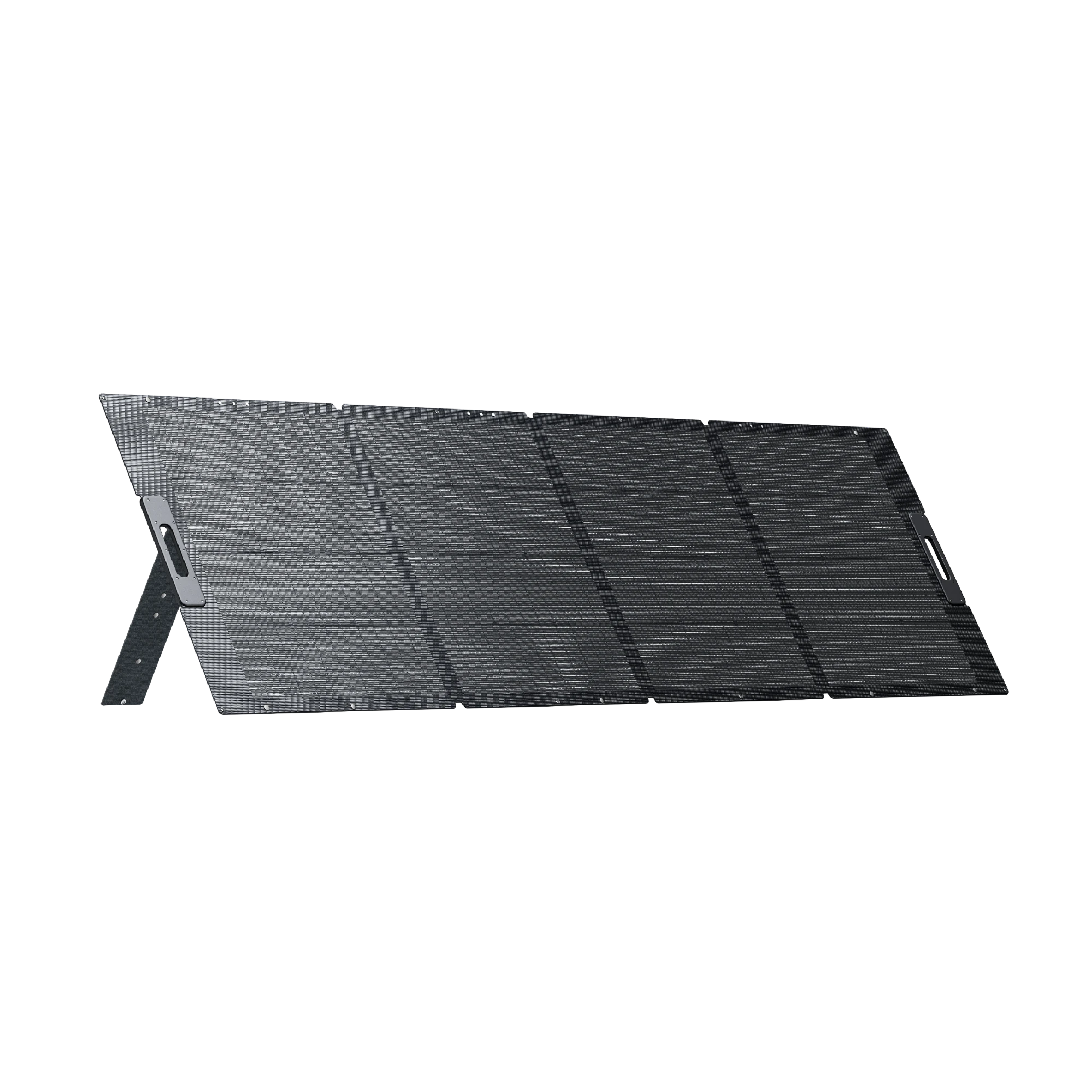
Weatherproof rigid panel for roof/ground arrays on cabins.

Foldable suitcase, USB+DC, ETFE-coated — pairs with Jackery stations.

Top-rated 2026, scales to mid cabins; LiFePO4.
Affiliate disclosure: GetWattLogic earns a commission on purchases made through these links, at no extra cost to you.