
Field notes
Overpaneling Explained: Can You Connect More Solar Watts Than Your Controller Rating?
September 12, 2026
"My charge controller is rated for 30 amps. Can I connect 600W of panels to it?" This is one of the most-asked solar questions on every off-grid forum, and the answer — which surprises people — is usually yes, safely, and it can actually improve your system.
It's called overpaneling, and it's a real, legitimate design technique. But it has hard limits you can't ignore. Here's the honest version.
The key insight: panels almost never produce their rated watts
A "400W" solar panel produces 400W only under standard test conditions (STC): 1,000 W/m² of light hitting it at exactly 25°C cell temperature, perfectly perpendicular. In the real world, you almost never see all three at once.
- A panel angled for winter sun at noon might see 800 W/m² of light → ~320W output
- A panel hot from summer sun (cells at 45°C) loses ~10% efficiency → ~360W
- A panel at a non-optimal angle in fall → ~300W
So a 400W "rated" panel realistically delivers 280–360W in most real conditions. That means a controller rated for 400W of input will rarely see 400W of input even from 400W of panels — let alone from 600W.
Why overpaneling can actually help
The most valuable solar watt isn't the noon peak — it's the shoulder hours (early morning, late afternoon, cloudy days). When light is weak, your 600W array might only produce 200W — well under your controller's 400W ceiling. In those conditions, more panel area means more captured energy even though your controller can't use the noon peak.
An overpaneled system:
- Starts charging earlier in the morning (more area to grab weak light)
- Charges later in the evening
- Charges more in cloudy weather
- Reaches full charge faster after a cloudy day
You're trading noon-peak capacity (which you rarely hit anyway) for shoulder-hour harvest (which is where most off-grid systems are starved). For off-grid, this is often a good trade.
The three numbers you must check
Overpaneling is safe only if none of these three limits are exceeded. Your controller's spec sheet lists all of them.
1. Max input current (amps)
This is the hard limit. If your controller is rated for 30A of input and your array can produce 35A in ideal conditions, the controller will either clamp the input (wasting power) or, on cheap PWM controllers, damage itself.
Most quality MPPT controllers can handle 10–20% overcurrent safely by clamping the input — they just stop pulling more. But don't push past the rated current. Check your array's short-circuit current (Isc), add 25% for safety (per NEC), and keep it under the controller's max input current.
2. Max input voltage (Voc)
This is the harder limit and the one that kills controllers. Solar panels in series add their voltage. If your controller is rated for 100V max input and you wire four 30V panels in series, that's 120V — the controller is dead the first cold, bright morning.
Panels produce higher voltage when cold. A panel rated at 30V Voc at 25°C can produce 36V at 0°C. Always compute series voltage using the panel's cold-weather Voc (listed on the datasheet as "Voc temp coefficient"), not the rated voltage. Then add 20% headroom.
Voltage limits are not survivable. Exceed them once and the controller is done. This is the one number you absolutely cannot overpanel past.
3. Max output current (amps to the battery)
This is the limit most people forget. Your controller's output to the battery is also rated, and it's usually lower than the input rating. If you have a huge solar array and a small battery, the controller will simply cap its output to protect the battery — you'll lose the extra panel capacity without damage, but you'll have paid for panels you can't use.
The overpaneling decision tree
- Check max input voltage (cold Voc). This is non-negotiable. If your series voltage (with cold-weather Voc × 1.2) exceeds the controller's max, you cannot overpanel by adding more panels in series — you'd have to add them in parallel instead (which raises current, see #1).
- Check max input current (Isc × 1.25). If you're under the controller's rating, you're safe to add panels up to the limit. If you're slightly over on a quality MPPT controller, it will clamp safely — but stay under.
- Check max output current. Make sure your battery can accept the charge current the controller will push. A 100Ah LiFePO4 battery is happy at 50A charge; a 50Ah battery should be charged at ≤25A.
A worked example
Controller: Victron MPPT 100/30 (max 100V input, 30A output, recommended array 440W, max array ~880W at 12V).
Panels: two 200W panels, each 24V Voc, 10A Isc.
- Series: 48V total (under 100V limit ✓), 10A (well under 30A input ✓). Cold Voc ~58V — still under 100V ✓. Safe to overpanel.
- Add a third panel in series: 72V nominal, ~87V cold Voc (under 100V ✓). Still 10A. Safe — you're at 600W into a "440W" controller, but well within voltage and current limits.
- Add a fourth in series: 96V nominal, ~116V cold Voc — over the 100V limit, do not do this. You'd rewire to 2 series × 2 parallel instead (48V, 20A — both under limits).
When overpaneling is a bad idea
- You're on-grid or grid-tied. Overpaneling only helps off-grid. A grid-tied inverter exports every watt — you want the noon peak.
- Your battery is already full by 10 a.m. If your system finishes charging early on most sunny days, more panels won't help — your bottleneck is storage, not generation. Add battery, not panels.
- Your controller is PWM, not MPPT. PWM controllers don't clamp excess current the same way; overpaneling a PWM controller is much riskier and rarely worth it.
The takeaway
Overpaneling by 20–30% (panel watts vs. controller rated watts) is common, safe, and often smart for off-grid systems — as long as you stay under the controller's voltage limit (with cold-weather Voc) and current limit. Beyond 30% overpaneling, you're usually wasting money — the controller clamps the extra and you've paid for panels that only help in low-light shoulder hours.
Before adding panels, read your controller's spec sheet for those three numbers (max input voltage, max input current, max output current). If you're not sure how to compute the series/parallel math for your array, the GetWattLogic calculator sizes the panel array, controller, and battery together so nothing gets missed. For current controller and panel models, see the Recommended Gear page.
Gear for this setup
Picks that match what this guide covers.
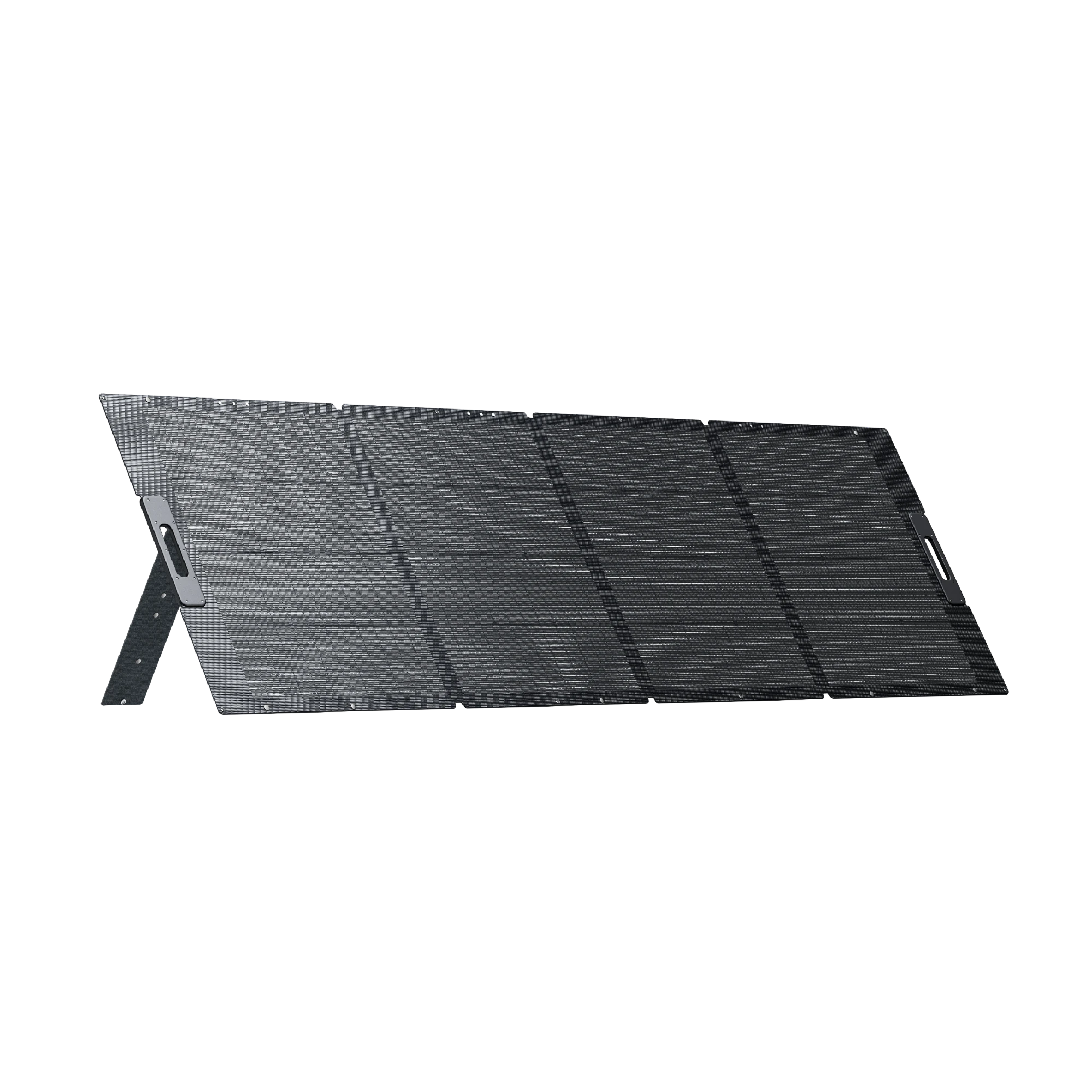
Weatherproof rigid panel for roof/ground arrays on cabins.
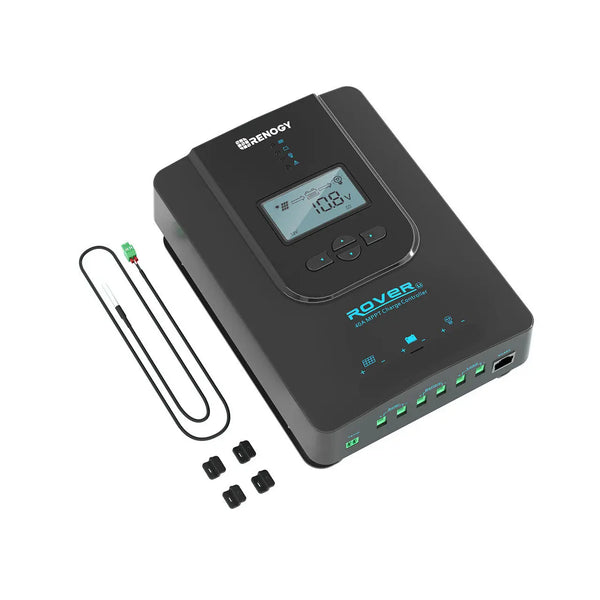
The default mid-size MPPT pick — Bluetooth monitoring and headroom for a cabin-scale array.
Affiliate disclosure: GetWattLogic earns a commission on purchases made through these links, at no extra cost to you.