
Field notes
Is Balcony Solar Legal in My State? (2026 Guide)
August 9, 2026
Is Balcony Solar Legal in My State? (2026 Guide)
Last updated: August 2026
If you're weighing a plug-in solar kit to run alongside your off-grid setup, the panels and microinverters aren't the hard part — the legal landscape is. Balcony solar (also called plug-in or plug-and-play solar) is one of the fastest-moving areas of state energy policy right now, and whether you can legally plug a kit into a wall outlet depends entirely on which state you're in.
Here's where things stand, state by state, and how to check your own situation before you buy.
What "balcony solar" actually means
A balcony solar kit is one to three lightweight panels paired with a microinverter that converts the panels' DC output into standard household AC power, then plugs directly into a normal 120V wall outlet. No roof work, no scaffolding, and — where it's legal — no electrician and no permit.
The core legal question every state is wrestling with is interconnection: whether feeding a small amount of self-generated power back into a household circuit through a regular outlet needs the same utility approval process as a full rooftop solar installation. States that have passed plug-in solar laws generally treat systems under a certain wattage cap more like a large appliance than a power plant.
States where balcony solar is legal and in effect
As of August 2026, these states have plug-in solar laws that are signed and currently in effect:
| State | Law | Wattage cap | Notes |
|---|---|---|---|
| Utah | HB 340 | 1,200W | First state to pass plug-in solar legislation (2025); most established market |
| Maine | LD 1730 | 1,200W | Effective July 2026 |
| Maryland | HB 345 | 1,200W | Systems under ~391W exempt from UL certification and building code changes |
| New Hampshire | SB 540 | 1,200W | Signed and effective July 2026 |
| Vermont | S.202 | 1,200W | Utilities barred from charging extra fees or requiring prior approval |
| Virginia | HB 395 / SB 250 | 1,200W | Localities cannot ban qualifying systems within the state cap |
States signed into law but not yet in effect
- Colorado — HB 26-1007, the most generous cap in the country at 1,920W, with a lower 395W tier that needs no electrician, permit, or HOA/landlord approval at all. Effective January 1, 2027.
- Connecticut — HB 5340, part of a broader energy bill. Effective October 1, 2026.
- New Jersey — The Garden State Balcony Solar Act (S2368) passed the legislature in July 2026 and is awaiting the governor's signature.
States with active legislation (not yet law)
New York's SUNNY Act has passed both legislative chambers and is awaiting the governor's signature. California's SB 868 has cleared Senate committee. Illinois, Massachusetts, Hawaii, Delaware, North Carolina, Indiana, Michigan, Minnesota, and Washington, D.C. all have bills at various stages. Roughly 30 states total have introduced or are actively considering plug-in solar legislation.
Everywhere else
If your state isn't listed above, there's no dedicated plug-in solar statute yet — which means legality isn't a clear yes or no. It comes down to your local utility's interconnection rules and your local electrical code. Some utilities are quietly permissive; others aren't. This is genuinely unresolved in most of the country right now, not a settled "no."
What to check before you buy, regardless of state
- UL 3700 certification. This is the safety standard written into most of the state laws above, and it's a reasonable bar to hold any kit to even where there's no law yet.
- Your specific utility's stance, not just your state's. Some utilities have their own interconnection tariffs that predate or sit alongside state law.
- HOA or landlord restrictions, if applicable — Colorado and Virginia explicitly override these; most other states don't yet.
- The wattage cap that applies to you. Most states cluster around 1,200W AC output per electrical meter; Colorado's lower tier (395W) and Maryland's exemption tier (391W) skip even more red tape.
Because this list changes month to month, treat it as a starting point and confirm current status with your state energy office or utility before installing.
Sizing an off-grid system to pair with — or instead of — a balcony solar setup? Try the free calculator to size your battery, panels, inverter, and generator based on your actual loadout.
Gear for this setup
Picks that match what this guide covers.
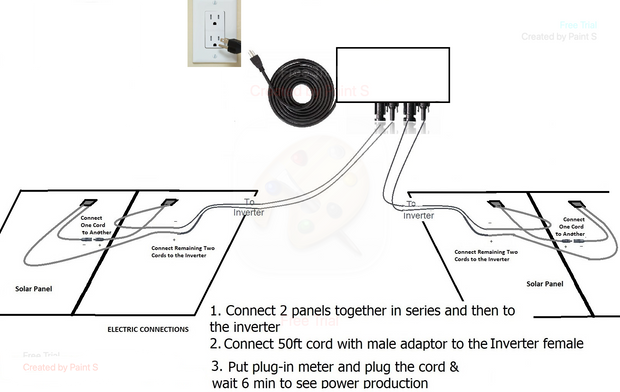
Plug-in grid-tie kit — 4× 200W panels + 800W microinverter + Wi-Fi monitor + 50ft cord. No electrician; starts at $699.

All-in-one balcony system combining microinverter + storage in one stack — higher upfront, everything in the box.
Affiliate disclosure: GetWattLogic earns a commission on purchases made through these links, at no extra cost to you.